
MYASTHENIA
GRAVIS
Autoimmune diseases arise from an overactive immune response of the body against substances and tissues normally present in the body. In other words, the body actually attacks its own cells.
This may be restricted to certain organs (e.g. in thyroiditis) or involve a particular tissue in different places (e.g. Goodpasture's disease which may affect the basement membrane in both the lung and the kidney). The treatment of autoimmune diseases is typically with immunosuppression—medication which decreases the immune response.
There are more than 80 different types of autoimmune disorders.
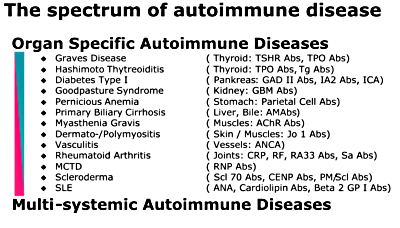
The spectrum of autoimmune disease spans conditions with involvement of a single organ (e.g. Hashimoto's thyroiditis) through to those with involvement of all systems in the body (e.g. SLE). The distribution of the auto-antigen largely determines the manifestations of the disease.
Introduction
What is an autoimmune disorder?
How do nerves transmit electrical impulses and communicate?

There are two types of nerve impulse transmission; the nerve impulse: electrical and chemical. Electrical events propagate a signal within a neuron, and chemical processes transmit the signal from one neuron to another or to a muscle cell. The chemical process of interaction between neurons and between neurons and effector cells occur at the end of the axon, in a structure called synapse. Touching very close against the dendrite of another cell (but without material continuity between both cells), the axon releases chemical substances called neurotransmitters, which attach themselves to chemical receptors in the membrane of the following neuron and promote excitatory or inhibitory changes in its membrane.
Neurotransmitters are chemicals made by neurons and used by them to transmit signals to the other neurons or non-neuronal cells (e.g., skeletal muscle; myocardium, pineal glandular cells) that they innervate.
The chemical binding of the neurotransmitter to the receptors causes a series of physiological changes in the second neuron which constitutes the signal. Usually the release from the first neuron (called presynaptic) is caused by a series of intracellular events evoked by a depolarization of its membrane, and almost invariably when an action potential takes place.
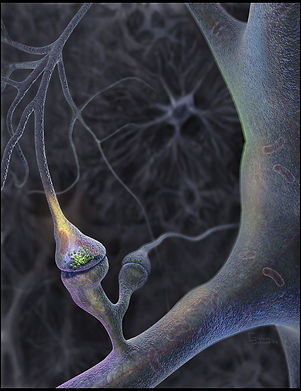
Synapse: As an electrical impulse travels down the "tail" of the cell, called the axon and arrives at its terminal, it triggers vesicles containing a neurotransmitter to move toward the terminal membrane. The vesicles fuse with the terminal membrane to release their contents. Once inside the synaptic cleft (the space between the 2 neurons) the neurotransmitter can bind to receptors (specific proteins) on the membrane of a neighboring neuron.
What triggers the release of a neurotransmitter?
Some mechanism must exist whereby the action potential causes the transmitter stored in synaptic vesicles to be expelled into the cleft.
The action potential stimulates the influx of Ca2+, which causes synaptic vesicles to attach to the release sites, fuse with the plasma membrane and expel their supply of transmitter. The transmitter diffuses to the target cell, where it binds to a receptor protein on the external surface of the cell membrane. After a brief period the transmitter dissociates from the receptor and the response is terminated. In order to prevent the transmitter from rebinding to the receptor and repeating the cycle, the transmitter is either destroyed by degradative action of an enzyme or it is taken up, usually into the presynaptic ending. Each neuron can produce only one kind of transmitter.
This essentially happens by means of the nerve impulse. A nerve impulse is the transmission of a coded signal from a given stimulus along the membrane of the neuron, starting in the point where it was applied. Nerve impulses can pass from one cell to another, thus creating a chain of information within a network of neurons.
How does Myasthenia gravis link the two?
Myasthenia gravis is the most common disorder of neuromuscular transmission. It is now one of the best characterized and understood autoimmune disorders. The hallmark of the disorder is a fluctuating degree and variable combination of weakness in ocular, bulbar, limb, and respiratory muscles. Weakness is the result of an antibody-mediated, T-cell dependent immunological attack directed at proteins in the postsynaptic membrane of the neuromuscular junction (acetylcholine receptors and/or receptor-associated proteins). The body's own antibodies break down the acetylcholine binding receptors on the post synaptic membrane, thus causing less amount of the neurotransmitter to bind, thus resulting in abnormal signal transmission to the muscle fibre.
Figure 1 :- The spectrum of autoimmune diseases
[4]
Figure 2:- A synapse
Figure 3:- Working of a synapse