
MYASTHENIA
GRAVIS
Symptoms
Symptoms of congenital Myasthenia gravis
Symptoms of congenital myasthenia usually appear in the first few years of childhood, but may not be noticeable until much later, occasionally remaining unrecognized until adulthood. If the symptoms begin in infancy, they usually appear as "floppiness" and a failure to meet developmental milestones, such as rolling over or sitting up. Some infants may also have episodes of choking or pauses in breathing. If the symptoms begin in toddlers or preschool children, they appear as weakness during physical activities or an inability to perform age-appropriate actions, such as running or climbing. In addition, if eye muscles are involved, children may have droopy eyelids, "lazy eye," or double vision. If mouth or throat muscles are involved, children may have difficulty speaking or swallowing. An important characteristic of myasthenia is that the weakness worsens during continuous activity, with strength returning, at least partially, after resting.
A symptom is something the patient feels and reports, while a sign is something other people, such as the doctor detect. For example, pain may be a symptom while a rash may be a sign. The following are the most common symptoms of myasthenia gravis. However, each individual may experience symptoms differently. Symptoms may include:
- Visual problems, including drooping eyelids (ptosis) and double vision (diplopia) and blurred vision (which may be intermittent).About two-thirds of people with MG initially have these symptoms. For about 15% of patients only the eye muscles are affected - in such cases their condition is known as ocular myasthenia.
- Severe muscle weakness and fatigue that may vary rapidly in intensity over days or even hours and worsen as muscles are used (early fatigue). Muscles become progressively weaker during periods of activity. Muscles improve after periods of rest
- Facial muscles - for approximately 15% of patient the first symptoms involve the throat and face muscle. In such cases individuals may have problems with:
- Speaking (dysarthria) - depending on which muscles are affected, speech may become soft or nasal.
- Swallowing (dysphagia) - the patient may choke easily, making eating, drinking, swallowing pills harder. Sometimes when the individual tries to drink, the liquid comes out of his/her nose.
- Chewing - muscles used for chewing may weaken considerably during a meal, especially if the person has been eating something hard or chewy, such as a steak.
- Facial expressions - some people may develop an unusual or different smile if certain facial muscles are affected.
- Exacerbations (worsening of symptoms) and remissions (easing of symptoms) may occur periodically during the course of MG. Remissions, however, are only rarely permanent or complete.
- Muscle weakness severity varies greatly among patients with MG. Sometimes the weakness may be in a localized form, such as just the eye muscles, while in other cases it may be in a severe or generalized form in which many muscles are affected; even those that control breathing.
-
Limbs - the arm and leg muscles may weaken, affecting such activities as lifting or walking (the patient's walk may seem like a waddle). When limb muscles are affected, this generally occurs in conjunction with other muscles in the body, such as the throat, eyes or face.


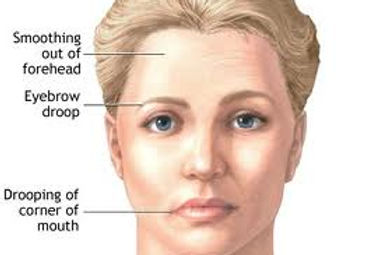
Figure 6 :- Ptosis
Figure 8 :- some other characteristics
Figure 7:- Arms fatigue